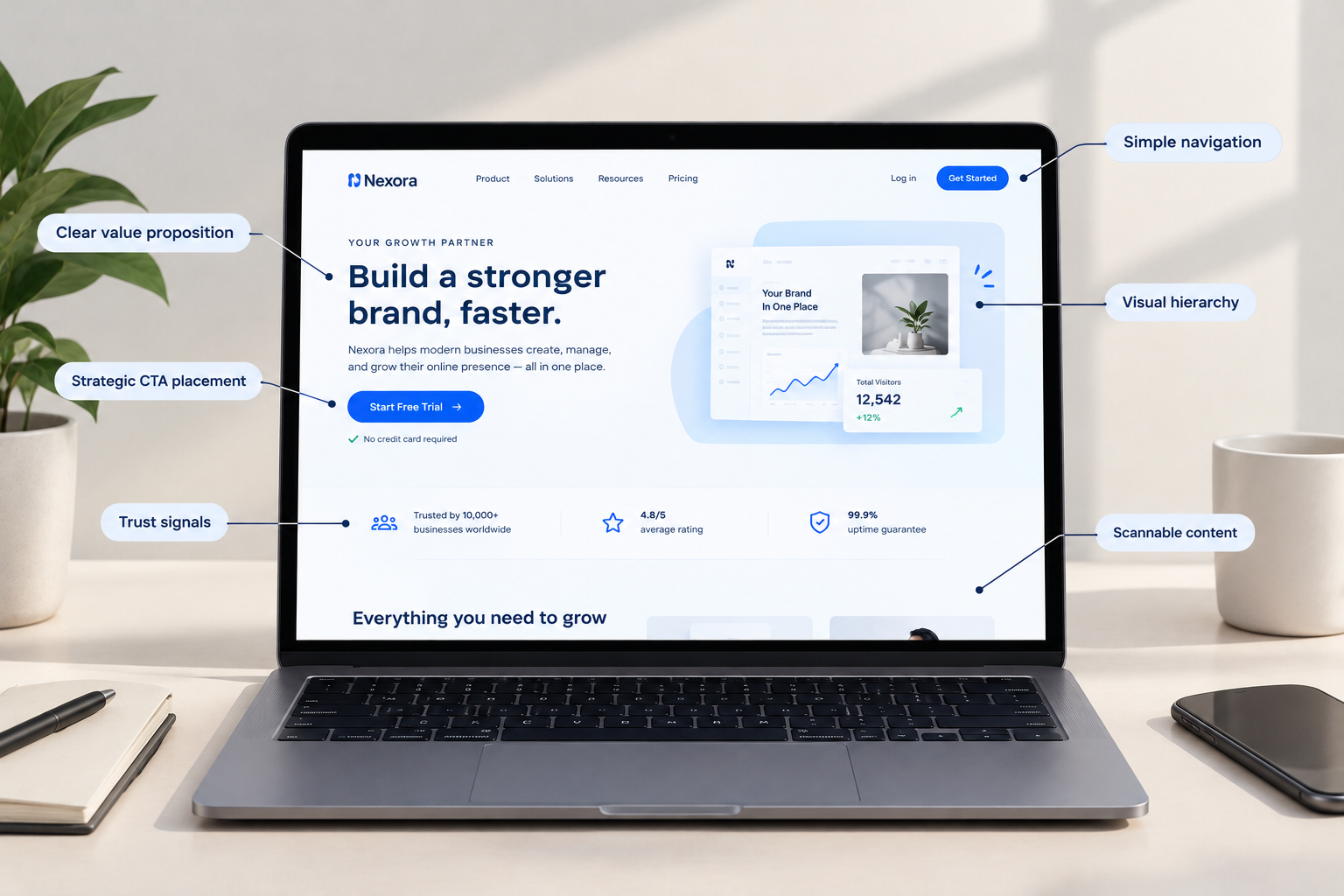
High traffic means very little if your website fails to turn passive visitors into paying customers or qualified leads. Adopting a conversion focused website design ensures that every visual element, headline, and call-to-action aligns directly with user intent, maximizing your ROI without increasing ad spend.
This practical guide breaks down the core principles, design elements, and user flow strategies required to transform standard web pages into high-converting revenue assets.
[Did You Know?] A conversion-focused page gives users a clear path from understanding the offer to taking the intended next action, eliminating unnecessary decision fatigue.
1. Defining Conversion-Oriented Web Design
Conversion-oriented web design is the practice of structuring digital interfaces specifically to guide users toward a predefined action, such as purchasing a product, filling out a lead form, or subscribing to a service.
Unlike purely aesthetic layouts, this strategic design framework blends user psychology, visual hierarchy, and functional UX:
- Visual Direction: Directs user eye movement immediately toward value propositions and action buttons.
- Frictionless Navigation: Removes unnecessary links and distractions that pull visitors off the conversion path.
- Psychological Triggers: Uses social proof, urgency, and trust badges to validate user decisions in real-time.
2. Core Pillars of Website Design for Conversions
Designing for higher revenue requires establishing a seamless blend of messaging and layout hierarchy. Implementing proven principles of website design for conversions ensures your message resonates immediately upon page load.
Clear Value Proposition Above the Fold
Your hero section must answer three fundamental user questions within five seconds:
- What product or service do you offer?
- How does it solve the user’s specific problem?
- What exact action should the user take next?
Strategic Call-to-Action (CTA) Placement
Use high-contrast primary buttons for main conversion actions and softer, secondary styles for exploratory clicks. Place CTAs consistently throughout the page journey—above the fold, after key value sections, and sticky at the bottom on mobile devices.
Streamlined Page Navigation & Layout
Keep conversion pages focused. Eliminate header navigation sub-links on dedicated landing pages to prevent visitors from leaking away from your main offer.
3. Integrating Conversion Rate Optimization (CRO) with Design
Combining visual design with continuous conversion rate optimization (CRO) allows you to refine layouts based on real user interactions and quantitative data.
| Design Focus Area | Standard Web Design Approach | Conversion-Focused Design Approach |
| Headline Structure | Creative, abstract brand slogans | Clear, benefit-driven value statements |
| Form Design | Long, comprehensive multi-field forms | Minimalist fields focused only on essential data |
| Trust Elements | Buried on a dedicated testimonial page | Embedded directly adjacent to conversion CTAs |
| Mobile Experience | Scaled-down desktop desktop view | Mobile-first touch targets with sticky bottom CTAs |
4. Key Elements That Drive Instant Conversion
Building a persuasive online experience requires strategic placement of trust and friction-reducing assets across the user journey:
- Social Proof Blocks: Showcase client logos, quantitative stats, and authentic customer testimonials near high-friction decision points.
- Risk Reduction Guarantees: Display money-back guarantees, free trial badges, or secure checkout seals directly below primary buttons.
- Microcopy & Form UX: Use actionable microcopy on buttons (e.g., “Get My Free Audit”) rather than generic text like “Submit.”
Checklist: Conversion-Focused Website Design Audit
[ ] Feature a clear, benefit-driven hero headline above the fold
[ ] Maintain high-contrast primary CTA buttons across desktop and mobile
[ ] Place social proof or trust badges near key action points
[ ] Limit form fields to minimum necessary requirements
[ ] Ensure mobile pages load rapidly with thumb-friendly buttons
[ ] Eliminate unnecessary external menu links on conversion landing pages
Conclusion
Implementing a conversion focused website design turns your site into an active sales engine rather than a passive digital brochure. By pairing clear visual hierarchy with friction-free user paths and trust elements, you turn casual visitors into loyal customers efficiently.